
How to Photograph Handbags for Fashion Brands: From Product Photography to Editorial Images
For a fashion brand, a handbag needs to be photographed in more ways than simply placing it against a white background. A strong handbag photography campaign should show the product accurately while also communicating the personality, style, and lifestyle of the brand.
Handbag photography can include clean e-commerce product images, photographs of the bag on a model, close-up detail shots, editorial images, campaign photography, and social media content. Each serves a different purpose, but together they create a complete visual identity for the collection.
As a New York City fashion and beauty photographer, I approach handbag photography as a combination of product photography and fashion photography. The goal isn’t simply to document the bag. It’s to create images that make people want to see it, wear it, and ultimately buy it.
Why Great Handbag Photography Matters
A handbag is a highly visual product.
Customers may notice the silhouette, leather, color, hardware, stitching, quilting, handles, or unusual construction before they know anything else about the product. Photography therefore plays an important role in how they perceive its quality and value.
For an emerging fashion brand, the photography may be one of the first things a potential customer encounters.
A beautifully designed handbag can look inexpensive if it is poorly photographed. Conversely, carefully considered lighting, styling, composition, and retouching can communicate craftsmanship and luxury.
This is why handbag photography for fashion brands requires more than technical product photography.
The images need to accurately represent the product, but they also need to express the brand.
Product Photography vs. Editorial Handbag Photography
One of the first decisions a brand should make is understanding the difference between product photography and editorial photography.
Product Photography
Product photography is primarily about information.
The customer needs to see the handbag clearly. The photograph should show its shape, proportions, color, construction, and important details.
Typical product images might include:
- Front view
- Back view
- Side view
- Interior
- Bottom
- Hardware
- Handles
- Strap
- Closure
- Detail shots
These images are especially important for an e-commerce website or product detail page.
The background is often simple and the lighting relatively controlled. The objective is consistency across the entire collection.
Editorial Photography
Editorial photography has a different purpose.
It is about creating an emotional response.
The handbag might be photographed on a model, in an interesting environment, or within a carefully styled fashion story. The lighting and composition can be more expressive.
Editorial images don’t necessarily need to show every product detail.
Instead, they communicate the world of the brand.
A customer should be able to look at the photograph and understand something about the person who might carry the bag.
The most effective handbag campaigns often combine both approaches.
Start With the Design of the Handbag
Before deciding how to photograph a handbag, I want to understand what makes that particular product interesting.
Every handbag has characteristics that should influence the photography.
Is the silhouette architectural?
Is the leather soft and supple?
Does it have distinctive quilting?
Is the hardware an important design feature?
Does the bag have an unusual handle?
Is the strap intended to be worn across the body?
Is it oversized?
Is it a small evening bag?
Is the interior particularly important?
These questions help determine how the product should be photographed.
A highly structured bag might benefit from directional lighting that emphasizes its geometry. A soft leather bag may look better with softer illumination that reveals its folds and texture.
The photography should respond to the design rather than forcing every product into the same visual formula.
Lighting Handbags to Show Shape and Material
Lighting is one of the most important aspects of handbag photography.
A handbag is a three-dimensional object, and the lighting needs to communicate that dimension.
Flat lighting can eliminate shadows and make a product easy to see, but it can also make a beautiful material appear flat.
Controlled directional lighting can create highlights and shadows that reveal the shape of the handbag.
Leather is particularly interesting because it responds strongly to light.
A glossy leather surface can produce attractive highlights, but uncontrolled reflections can also become distracting. Matte leather, suede, nylon, woven materials, and textured fabrics all react differently.
The photographer needs to understand the surface and adjust the lighting accordingly.
The objective isn’t simply to make the handbag bright.
The objective is to make the material look like the material it actually is.
Good handbag photography should allow the viewer to almost feel the leather through the photograph.
Photographing Handbags on a Model
Once the basic product photographs have been created, photographing the handbag on a model introduces an entirely different dimension.
The model provides scale.
A viewer can immediately understand how large the handbag is and how it sits against the body.
The model also provides movement and personality.
A shoulder bag can be photographed naturally while walking. A large tote can be carried against the body. A smaller bag can become part of an evening look.
The model’s pose should support the product.
Hands, arms, shoulders, and body position can all be used compositionally to direct attention toward the handbag.
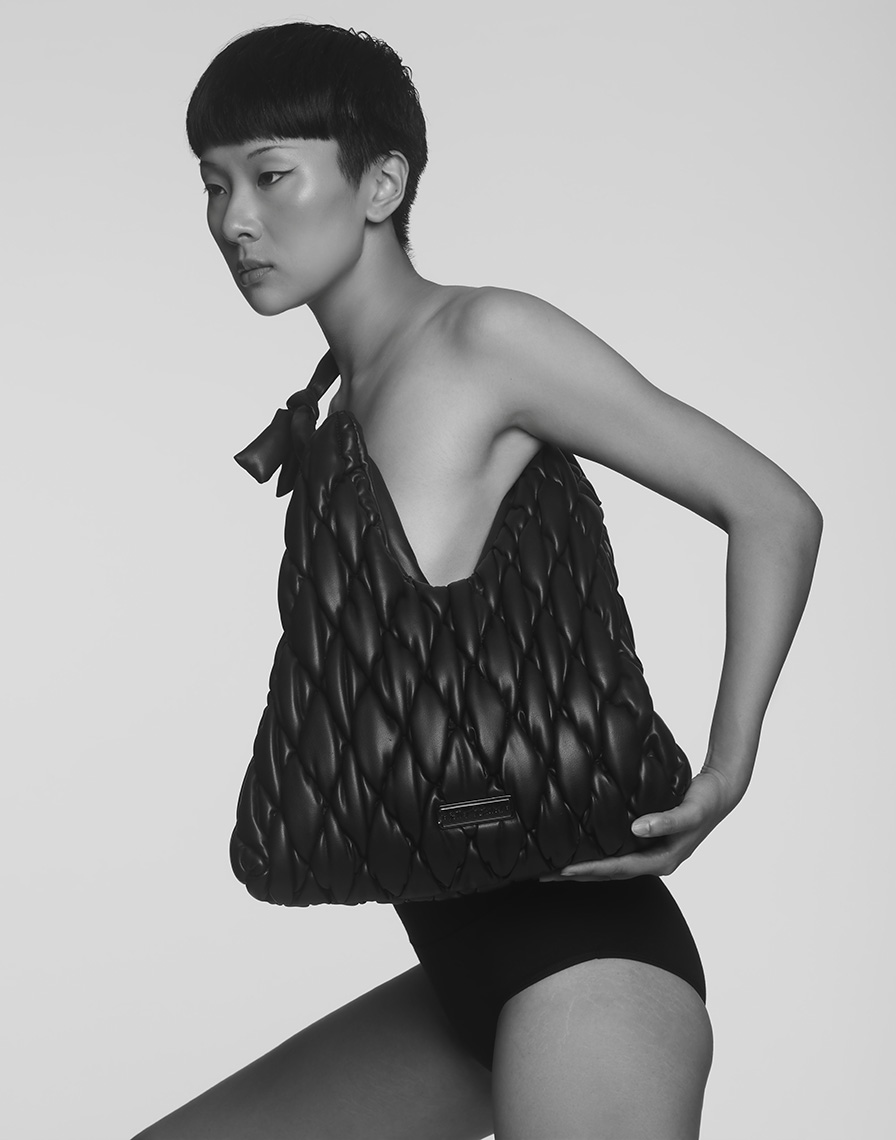
The photograph accompanying this article is an example of this approach. The model’s arm creates a strong diagonal line through the composition while her hand supports the bottom of the bag. The pose communicates the size and shape of the handbag while remaining visually fashion-oriented.
The photograph isn’t simply showing someone holding a bag.
It is creating an image around the bag.
Styling the Handbag
Styling is an important part of fashion accessory photography.
The clothing should complement the handbag without competing with it.
This doesn’t necessarily mean that the clothes need to be simple.
Contrast can be extremely effective.
A structured handbag might look great with soft, flowing clothing. A highly textured bag might be photographed against a clean, minimal outfit. A colorful handbag could become the central color element within an otherwise restrained styling concept.
The styling should reflect the brand’s customer.
Luxury handbag photography may require a sophisticated, minimal approach. A contemporary streetwear brand may benefit from something more energetic. A designer collection might call for a highly conceptual editorial treatment.
There is no universal formula.
The important thing is that the handbag, model, clothing, and environment feel as though they belong to the same visual world.
Showing the Details
A campaign shouldn’t rely entirely on wide or full-body photographs.
Close-up images are extremely valuable.
A tight photograph can reveal:
- Leather grain
- Stitching
- Quilting
- Zippers
- Clasps
- Buckles
- Logos
- Embossing
- Handles
- Hardware
- Interior construction
These details help communicate craftsmanship.
They are particularly important for premium and luxury accessories, where construction and materials are part of the value proposition.
A close-up can also become a useful piece of social media content.
One handbag shoot can therefore generate a variety of images rather than a single hero photograph.
Creating a Consistent Collection
When photographing an entire handbag collection, consistency becomes extremely important.
The photographs should feel as though they belong together.
That means maintaining consistency in:
- Lighting
- Background
- Camera angle
- Cropping
- Color
- Styling
- Model direction
- Retouching
If one handbag is photographed with soft light and another with extremely dramatic light, the collection may feel disconnected.
This doesn’t mean every photograph needs to be identical.
There should be enough consistency that the brand’s visual identity remains recognizable while allowing individual products to have their own personality.
This is particularly important for e-commerce.
Customers should be able to move from one product page to another and feel that they are looking at the same brand.
The Importance of Color
Color can completely change how a handbag is perceived.
Black handbags require careful lighting because dark surfaces can easily lose detail. White and pale handbags require attention to highlight control. Bright colors need accurate color reproduction.
Color management is therefore an important part of professional handbag photography.
But color isn’t only a technical consideration.
It is also a branding decision.
A brand might want neutral, understated imagery, or it might want saturated colors and strong contrast.
The photographer needs to understand both the product’s actual color and the brand’s desired visual language.
Black-and-White Handbag Photography
Not every handbag photograph needs to be in color.
Black and white can be especially effective for editorial campaigns where shape, texture, lighting, and composition are more important than color.
In the accompanying photograph, the monochrome treatment emphasizes the sculptural quality of the quilted handbag. The absence of color directs attention toward the relationship between the model, the bag, the highlights, and the shadows.
Black and white can also make an accessory photograph feel more timeless and editorial.
It isn’t necessarily the best choice for an e-commerce product page, where accurate color representation is important. But as part of a fashion campaign, it can provide another visual dimension.
Photographing the Bag in Context
A handbag doesn’t exist in isolation.
It belongs to a particular lifestyle.
This is why location photography can be so powerful for accessories.
A handbag might be photographed:
- On the street
- In a hotel
- In a restaurant
- In an apartment
- In an architectural environment
- In a studio
- At an event
- In a city environment
The location can tell the viewer something about the brand.
A minimalist studio can make the handbag feel sophisticated and sculptural. A city environment can communicate energy and contemporary fashion. An elegant interior can suggest luxury.
The important thing is that the environment supports the product rather than distracting from it.
Creating Images for Social Media
Today’s handbag photography also needs to work across multiple platforms.
A campaign photograph might appear on a website, Instagram, Pinterest, digital advertising, email marketing, or a retailer’s website.
That means it’s useful to photograph with different crops and orientations in mind.
Vertical images can work particularly well for social platforms and mobile viewing.
Horizontal photographs may be useful for website banners.
Tighter crops can become social media posts or advertisements.
Detail photographs can provide additional content between major campaign images.
Thinking about these applications before the shoot can significantly increase the value of the photography.
E-Commerce and Campaign Photography Should Work Together
One of the most efficient approaches for a fashion brand is to plan e-commerce and campaign photography as part of the same production.
The clean product photographs provide the information customers need.
The campaign photographs provide the emotional connection.
The editorial images create brand identity.
The detail photographs communicate craftsmanship.
Together, they create a complete visual system.
Rather than treating each photograph as a separate assignment, the photographer can plan a shoot that produces a wide range of usable content.
This can be particularly valuable for emerging brands working with limited production budgets.
Retouching Handbag Photography
Retouching should enhance the photograph without making the product misleading.
For handbags, that can mean removing dust, small imperfections, distracting reflections, or temporary marks created during production.
The goal should be to maintain the real character of the product.
Over-retouching can make leather look artificial.
Texture can disappear.
Natural highlights can become unnatural.
For fashion photography, I generally prefer retouching that feels polished but believable.
The viewer should see the craftsmanship of the product rather than the retouching.
Planning a Handbag Photography Shoot
A successful handbag photography shoot begins well before the camera is set up.
The photographer and brand should discuss:
What is the objective?
Is the shoot primarily for e-commerce, a new campaign, advertising, social media, or all of these?
What products need to be photographed?
How many handbags are involved?
What images are required?
Are front, back, detail, model, editorial, and lifestyle images needed?
Where will the photographs be used?
Website, advertising, social media, print, lookbook, or retail?
What is the visual direction?
Minimal, luxurious, contemporary, experimental, classic, or editorial?
Answering these questions early helps prevent a shoot from becoming a collection of disconnected photographs.
What Makes a Successful Handbag Photograph?
Ultimately, successful handbag photography has to accomplish several things at once.
It needs to show the product accurately.
It needs to make the material look appealing.
It needs to establish scale.
It needs to communicate the brand.
It needs to attract attention.
And, most importantly, it needs to make the viewer want the product.
That last part is easy to overlook.
Photography isn’t merely documentation. For a fashion brand, it is part of the sales process and part of the brand identity.
A customer may never touch the handbag before purchasing it. The photograph has to communicate some of that experience.
What does the leather look like?
How large is the bag?
How does it sit on the body?
What does it feel like to carry?
What kind of person carries it?
What does owning it say about the customer?
The strongest photography begins answering those questions without ever having to state them.
Final Thoughts
Great handbag photography requires an understanding of both the product and fashion.
A handbag needs to be photographed accurately, but it also needs to exist within a visual world.
That’s why I believe the best approach combines product photography, model photography, editorial photography, and lifestyle imagery.
The clean product photograph tells the customer what the handbag looks like.
The model photograph shows how it is worn.
The detail photograph communicates craftsmanship.
The editorial photograph communicates desire.
And the campaign as a whole communicates the identity of the brand.
For fashion and accessories companies, the goal shouldn’t simply be to produce photographs of handbags.
The goal should be to create a visual language that makes the handbags recognizable, desirable, and memorable.
That is what professional handbag photography can do for a fashion brand.

